Daily Habits to Track: 18 Ideas and a Rule Builder
Good daily habits to track are actions you can describe and record honestly: review three vocabulary words, put away five desk items, or write tomorrow’s next action. Choose one that matters to you, decide what counts as complete, and match the record to its real schedule. A daily checkbox is only one option; amounts and occasional actions need a different record.
Use the 18 ideas below as starting points, then try the rule builder. It helps you choose between a personal record, numeric tracking, planned days, and a common daily goal with another person. The free weekly record sheets give you a place to keep the rule and reports.
Published by MYOHO Group LLC, the developer of DuoKeep. Product rules were checked on October 8, 2026. These habit quantities and cues are proposed examples, not prescribed targets or results from a reader trial. See how we write our guides.
Choose one action that solves a real problem
Start with an action you actually want to repeat. If you keep forgetting a language you are learning, a short review may be useful. If your desk is difficult to work at, clearing a defined area may matter more than adding another study row.
Ask whether the opportunity exists in your normal day and whether you will know what happened. “Become fluent” is a long-term outcome. “Review three words after breakfast” describes an action you can attempt today. A clear record still does not prove you remembered the words later.
If the action supports a finished result, use our free goal-setting worksheet to plan the result’s acceptance conditions and review them separately from daily action reports.
For a first attempt, choose one action and one record. That is a practical starting suggestion, not a scientific limit on how many habits a person can build. Add another only when recording it would answer a useful question, rather than make the grid look fuller.
18 ideas to adapt to your own routine
The quantities below are examples you can change before starting. The cue tells you when an opportunity might occur; it does not require a perfect day. Some ideas fit selected days or a particular event better than every day, especially trips, messages and conversations.
Learning and making
| Habit idea | Proposed completion rule | Possible cue |
|---|---|---|
| Vocabulary review | Review at least 3 vocabulary words. Count words actually reviewed; a saved lesson is not a review. | After breakfast |
| Reading | Read for at least 2 minutes. Reading is the action; putting out the book is preparation. | After your evening meal |
| Instrument practice | Practise your chosen passage for at least 3 minutes. Choose a passage or exercise; do not require a flawless performance. | After putting down your work bag |
| Recall practice | Attempt at least 2 practice questions without looking at the answers. An attempt counts even if wrong; keep correctness separately if needed. | After opening your study notes |
| Draft writing | Write at least 50 new draft words. Count new draft words; editing old words is a different action. | After opening your document |
| Sketching | Sketch for at least 3 minutes. Time spent drawing counts; liking the result is not a completion test. | After setting out your pencils |
Home and preparation
| Habit idea | Proposed completion rule | Possible cue |
|---|---|---|
| Desk reset | Return at least 5 desk items to their places. Only moved items count; inspecting the desk alone does not. | Before leaving your desk |
| Prepare a bag | Pack the essential items for your next planned trip. Choose the essentials beforehand; no trip means no planned opportunity. | After checking tomorrow’s plans |
| Digital filing | Move or name at least 3 loose files in your chosen folder. Choose one folder; do not demand a completely tidy device. | Before closing your computer |
| One surface reset | Clear your chosen work surface for its next use. Define which surface and what clear means before tracking. | After finishing the current activity |
| Shopping list check | Check your next-day essentials and update the shopping list if needed. The check counts when no item needs adding; an empty list is valid. | After clearing the kitchen |
| Tomorrow’s calendar | Review tomorrow’s calendar and note one preparation task or none needed. No preparation needed is a valid result after an actual review. | Before your evening wind-down |
Attention and connection
| Habit idea | Proposed completion rule | Possible cue |
|---|---|---|
| Next-action note | Write the next concrete action for your chosen task. Use a verb and an object, such as open the draft and write the heading. | Before closing your work session |
| Protected focus | Work on one chosen task with your phone put away for at least 10 minutes. Choose an arrangement that keeps necessary calls available. | At the start of a planned focus session |
| Journal note | Write at least 1 sentence about one thing you noticed today. A neutral observation counts; you do not need to feel grateful. | After brushing your teeth |
| Keep in touch | Send one check-in message to a person you chose. Keep this weekly if that suits the relationship; no reply is required for your action. | After a planned weekly cue |
| Phone-away conversation | Put your phone away for at least 5 minutes of a mutually agreed conversation. Use a real opportunity; another person does not owe you a daily conversation. | When a willing conversation starts |
| Hobby time | Spend at least 5 minutes on your chosen hobby. Name the activity; enjoyment or achievement is not the completion test. | After setting out the materials |
These are observable activities, not promises about grades, productivity, relationships or health. Pick the activity you want to make room for. If reading is your choice, our reading habit guide covers choosing a book and adjusting the routine in more detail.
Build a rule and choose how to record it
Choose an idea, adjust its quantity and cue, and select the schedule and record you want. The result explains the tracking format that fits those choices. Copy the plan before leaving; this tool does not save it or send your entries to us.
Before starting, add your actual planned days if needed and a review date. If two people share a goal, agree on the same completion rule and how much detail each person wants to share. Different personal cues are fine; one person’s report does not complete the other person’s action.
Use a record that preserves the information you need
A yes/no mark answers whether a rule was met. A quantity log answers how much you did. A schedule tells you which opportunities were planned. Decide which question you want the record to answer before choosing an app.
| Your situation | Start with | Check before you choose |
|---|---|---|
| One clear action each day | A yes/no grid with room for a short note | Write the completion rule beside the grid; distinguish an absent report from a confirmed miss. |
| The amount matters, including partial attempts | A number log, counter or timer | Keep the unit and actual amount. A Done mark alone cannot distinguish three words from thirty. |
| Only some days or opportunities are planned | A schedule or opportunity-based sheet | Count planned opportunities; do not treat every other calendar day as a failed attempt. |
| Two people want separate habits | Separate records with optional sharing | Do not force different actions into a single common completion rule. |
For example, two words reviewed toward a three-word rule is a partial attempt. If your rule was one word, those same two words meet it. Define the rule in advance and keep any change for future attempts; a new minimum does not rewrite earlier results.
Free weekly record sheets for one person or two
Use these free two-page PDFs to turn your rule into a seven-day record. Page one is for your own action; page two keeps two people’s reports beside one common completion rule. Choose the same paper size as your printer. No email, account or DuoKeep app is required.
Want to enter quantities and see automatic summaries of planned days? Our free Google Sheets habit tracker keeps blanks, zeros and partial amounts distinct, with optional independent reports from a friend.
For a longer paper record, download our free 30-day habit tracker printable or print a dated calendar month with planned weekdays. Both offer a solo page or two independent reports under one rule.
Fill either PDF in a reader that supports forms, then save a local copy, or print the page you need and write by hand. A4 is 210 × 297 mm; US Letter is 8.5 × 11 inches. Print one page per sheet at actual size; use “Fit to printable area” if an edge is clipped.
Copy the action and minimum from the builder into the rule field. Add the actual planned days, start date and reporting cutoff. Day 1 is the start date and each row follows it by one calendar day. For different personal rules, each person can use a separate copy of page one.
- D: Complete. The written rule was met. Add an amount if it matters.
- P: Partial. Some of the action happened, but it did not meet the minimum.
- M: Confirmed miss. The person reports that the planned action did not happen.
- ?: Unknown. The reporting cutoff passed without a report. Do not infer what happened.
- N: Not scheduled. No opportunity was planned. Leave future days blank.
In a fictional three-word example, Alex writes “P 2 words” and Sam writes “D 3 words” in their own columns. Only Sam met that rule; the sheet still preserves Alex’s actual amount. These are worksheet labels, not DuoKeep controls. Paper offers no live sync or reminders, and the PDF does not calculate completion or streaks.
Paper and a shared note can handle a simple record. For an app, compare six habit tracker apps and use the trial sheet to check your record unit, schedule, devices and audience. For pair-specific details, see our shared habit tracker comparison.
A shared vocabulary rule in DuoKeep
DuoKeep fits two people who already know each other and want to follow one common daily completion rule. Each person reports their own completion or rest day. It is a manual shared record; it does not count vocabulary words, time a session or test recall automatically.
Suppose two friends are learning different languages. They agree to “Review at least three vocabulary words” each day. One uses breakfast as the cue; the other uses the end of lunch. Their words and materials differ, but their completion rule is the same.

DuoKeep · Habits for two
One goal. Two people.
Start together.
Build a daily habit with a friend or partner. Each person checks in separately, and each pair gets one active goal free.
Free to start. DuoKeep Plus is optional. Store availability and purchase prices vary by country.
Put the agreed rule into the goal
- Create a New promise titled “Review at least 3 vocabulary words.” Set a deadline you both want and check the displayed goal time zone.
- Choose reminder settings you want, then invite the other person with the code or QR code. The other person joins with the invitation.
- After the actual review, each person saves their own report. Add a short note if the amount or an obstacle would help the next conversation.
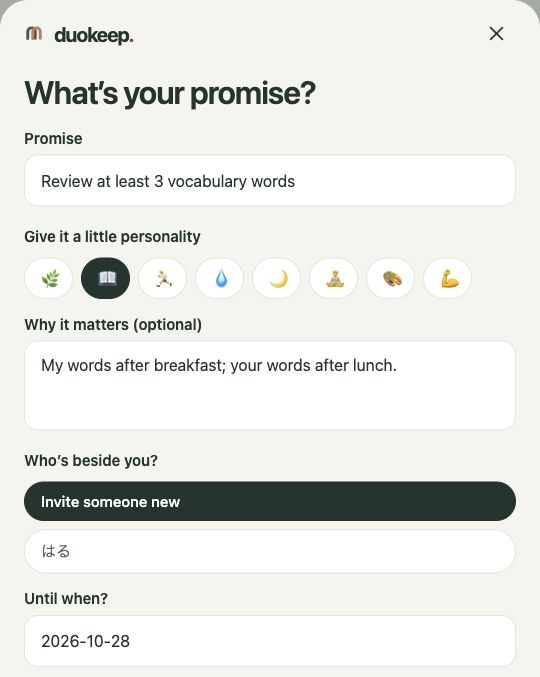
The developer’s local-preview screens below show the example rule and a saved partial-attempt note. We operated these forms to check the setup and report flow. We did not review a lesson, run a live two-person sync test or measure learning outcomes.
Keep partial work, rest and missing reports separate
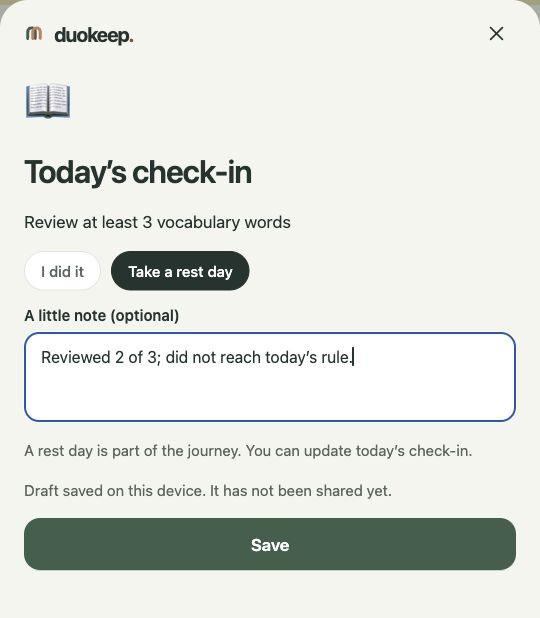
If someone reviews only two words, they have not completed this three-word rule. In DuoKeep, they can record a rest day and explain the partial attempt in the note. The app has no separate numeric progress stage; the note preserves that context manually.
| Example report | Interpretation | Next adjustment |
|---|---|---|
| “Reviewed three words.” Both people choose I did it. | Both met the agreed minimum on the goal date. Extra words are optional context. | Keep the rule if it still fits the purpose. |
| “Reviewed two of three; did not reach today’s rule.” One records rest. | There was a partial attempt, not a completed three-word action. | Ask whether the cue or quantity should change for future days. |
| No saved report from one person | You do not know whether the action happened. | Follow the reminder agreement; do not invent a completion or blame someone for a guessed miss. |
These reports are fictional interpretations of the proposed rule. DuoKeep’s shared-streak day requires both people to choose Done on the same goal date. A saved rest does not count as a completed shared day; an ended day without both completions interrupts the streak while the history remains.
The goal uses the creator’s time zone for both people. If the friends live in different zones, check that their two reporting times fit that shared date. If they want a weekly quota, numeric progress, or different personal rules, keep those records in a format that supports them instead of changing the plan to fit a daily streak.
Each pair gets one active goal free. For the report and reply responsibilities, our accountability partner guide includes an agreement you can adapt. Agree on wanted reminders and a review date before starting.
Review the plan before adding more rows
At the date you chose, ask what the record changed. Did the cue give you an opportunity? Was the amount realistic? Did the record preserve the information you wanted? Did sharing help either person decide what to do next?
Change one part when you can explain the reason. If the action was useful but breakfast rarely happened at home, choose a cue that actually occurred. If the amount was unnecessarily large, lower the future minimum and keep the earlier record honest. If tracking no longer answers a useful question, stop that row rather than keep collecting ticks.
Does a 21-day streak mean a habit has formed?
No. A streak records completed actions under a rule; it does not establish that starting the action has become automatic. You can choose day 21 as a convenient review date, without treating it as a scientific deadline.
In Lally and colleagues’ habit-formation study, 96 volunteers chose a daily eating, drinking or activity behaviour and reported its automaticity for 12 weeks. There were enough data from 82 people; curves were fitted for 62, with a good fit for 39. Estimated times to approach the modelled plateau ranged from 18 to 254 days. Estimates beyond the 84-day follow-up were projections, not observed 254-day runs.
The researchers also found that one missed opportunity did not materially change the formation process in that study. That finding does not make repeated misses irrelevant, or mean a tracker’s streak must stay intact. In a 2026 interview, Lally emphasised that 66 days is not a deadline for everyone.
A 2024 systematic review of health-habit research included 20 studies, but only four reported formation times, and 11 were rated at high risk of bias. These findings do not supply a formation date for your desk reset or vocabulary practice.
Use three weeks of reports to choose the next adjustment
Compare what happened with how the action started. For a proposed desk-reset rule, that could mean putting away five items after closing your work laptop, then briefly noting whether you noticed that cue, a reminder prompted you, or you started at another moment. These are planning notes, not an automaticity test or a pass score.
In a fictional 21-day record, Alex and Sam each have 15 completed days, three confirmed misses and three unreported days. Alex’s notes say a friend prompted 12 of the 15 starts; Sam’s say that happened twice. Equal completion counts leave different questions to discuss. Keep support both people want; do not remove reminders just to test someone.
| Example report | Interpretation | Next adjustment |
|---|---|---|
| Most recorded starts followed a friend’s message. | The action happened with support; the count alone cannot show automatic starting. | Keep agreed support and make the chosen cue easier to notice, such as leaving the storage box beside the laptop. |
| Completion is recorded, but there are no notes about starting. | You know the result, not how it started. | If that question matters, add a brief start note next week. Do not infer automaticity from the ticks. |
| Several planned days have no report. | Some results are unknown. | Clarify reporting before changing the habit rule. Keep missing reports separate from confirmed misses. |
| The work-laptop cue did not occur on days off. | The intended daily opportunity was absent. | Choose a cue that fits those days, or use a record that supports a workday schedule. |
Choose one change for the next review: keep the plan, adjust its future cue or amount, improve the report, or stop an action you no longer want. Keep earlier entries under their original rule. The weekly record sheets have room for notes; in the Google Sheets tracker, keep start notes separately. Neither resource calculates when a habit has formed.
Questions before you start
What are good daily habits to track?
Choose actions that matter to you and have a real daily opportunity: a brief vocabulary review, a next-action note or a defined desk reset. Specify what counts as done. The best starting idea depends on the problem you want to address, rather than a universal list of essential habits.
How many habits should I track at once?
For a first attempt, choose one so you can inspect its rule and logging routine. There is no fixed maximum established by this guide. Add another only when the first record is manageable and the new row would serve a clear purpose.
Can I track a habit I want to stop?
Define the observation window and what you will record. You might record an observable alternative, such as putting the phone away during one planned task. If you record occurrences of an unwanted action, keep the count and context. A missing report cannot prove the action did not happen.
Should I keep tracking something I already do?
Keep it if the record still answers a question you care about, such as whether a changed schedule made the action harder. If it tells you nothing new and logging has become a chore, you can retire that row. You do not need a permanent tick for every routine.
Sources and method
We compared habit-idea guides and their record formats, then wrote these proposed rules and the selector’s decision logic. HabitLab’s idea guide and Habit Builder already connect cues and actions; init.Habits and Mosaik discuss quantity and schedule choices. These are existing useful approaches, not ideas we invented.
We also reviewed printable resources. Productify already provides monthly and weekly sheets with a worked example; Habit Radar includes flexible weekly targets. Our record kit connects this guide’s rule to separate amount/status reports, with one-person and two-person pages.
DuoKeep’s App Store description, Google Play listing and implementation rules support the product details above. The screens are local UI demonstrations. The selector is a practical decision aid, not a validated assessment or a guarantee of lasting habits.
If you choose the same daily rule with someone you already know, DuoKeep gives you two individual check-ins on one goal. Choose it when that shared record is the part you want.
DuoKeep · Habits for two
One goal. Two people.
Start together.
Build a daily habit with a friend or partner. Each person checks in separately, and each pair gets one active goal free.
Free to start. DuoKeep Plus is optional. Store availability and purchase prices vary by country.
More habit guides
Browse our habit guides for choosing an app and planning a goal together.

Habit guide
Goal Tracker Apps: 5 Options by What You Need to Record
Choose a goal tracker app for finished results, assigned tasks or two daily reports. Compare five options, free limits and sharing conditions.
Read the guide
Habit guide
Apps for Couples: Questions, Calendars and Daily Habits
Choose among five apps for couples by the result you want to share, both partners’ access, free limits and the first thing to check together.
Read the guide