How to Build a Reading Habit You Can Keep
To build a reading habit, choose a book you want to open, attach a short reading session to something you already do, and decide what counts as enough before you start. Keep a bookmark or note that tells you where to resume, then review what interrupted you instead of treating a missed day as a restart.
You can do this alone. If a friend wants to read regularly too, you can keep your own books and schedules while sharing one simple completion rule. Below is a routine you can copy, with examples of what to change when it stops fitting.
Choose a book and a reading slot you can return to
Start with something you are interested in now and a moment that already happens in your day. You do not need a difficult classic, a yearly book target, or a new app to begin.
Open a sample, a short story, or a few pages of a book you already have. If choosing takes longer than reading, pick from those available to you and save the rest for later. You can ask a librarian for books similar to one you enjoyed; borrowing does not require committing to finish every book.
Name the moment and put the book there. For example: “After I put my breakfast plate away, I will read at the kitchen table.” Leave a paper book with its bookmark on the table, or have the ebook ready at the last page you read. If social apps interrupt an ebook session, silence notifications or use a separate reader if you have one.
James Clear’s reading habit guide at Penguin Random House also recommends making books visible, choosing a small starting action, and reading what interests you. These are useful starting choices; the routine below adds a way to decide what to record and what to change.
Should you track minutes, pages, or a chapter?
Choose the unit that matches your purpose. Minutes protect a small slot in your day; pages measure progress through a particular book; chapters fit a shared discussion deadline. None is a universal minimum for forming a reading habit.
| Your situation | Start with | Check before you choose |
|---|---|---|
| Your available time varies, or you and a friend have different books | A small number of minutes | Use actual reading or listening time. Time choosing a book or opening the tracker does not count. |
| You want steady progress through one paper book or edition | A small page target | Page density and editions differ. A page total is not a fair comparison between different books. |
| You are reading the same book for discussion | An agreed chapter or stopping point | Check chapter length and the meeting date. A weekly deadline may need a weekly planner rather than a daily shared streak. |
For a first routine, you might aim for ten minutes and agree that two minutes counts as completion on a busy day. Those numbers are our suggested trial settings, not research thresholds. If two minutes is still unrealistic, choose a smaller action you can describe honestly, such as reading one paragraph.
Put the minimum in the rule itself. If your rule says “ten minutes,” a two-minute session has not met it. If the rule says “at least two minutes,” both two and ten qualify, and you can keep the longer amount in a note. Change an unsuitable rule openly rather than changing what “done” means after the fact.
Read with a friend without choosing the same book
A friend can share the routine without matching your taste, speed, or reading time. Agree on the minimum action and the kind of reply you want, then let each person choose their own book.
Here is a fictional example, not a customer result. Maya chooses a short-story collection and reads after breakfast. Leo chooses a history book and reads after dinner. Both are in Tokyo and try the same rule from October 8 to 14, with a review on October 15.
Our rule: read our own book for at least two minutes each day. We aim for ten when it fits. Each person reports their own session; we acknowledge the report by the next morning. We do not compare pages or send reminders unless asked. At the review, we decide whether to keep or change the plan.
If you want discussion instead of a daily check-in, choose the same book and agree on a spoiler boundary and a meeting date. If you want to sit and read together, arrange a time in your usual calendar or chat. A completion tracker does not provide the conversation or the reading session.
No willing friend yet? Start the solo routine today, or use our guide to finding an accountability partner. You do not have to postpone reading while looking for someone.
Set up a reading record you will actually use
A notebook with the date, amount, and next starting point is enough. Add a shared record only if seeing each person’s report serves the arrangement you made.
For the Maya and Leo example, DuoKeep can record each person’s completion against one shared daily rule. It is the app we make at MYOHO Group LLC. It does not choose books, supply a reading timer, or find a reading friend; use a separate timer if you want one and your usual chat for replies.
One active goal per pair is free. Plus is optional for additional active goals. The relevant product descriptions and setup were checked on October 8, 2026; see our editorial policy. If you need book shelves, reading statistics, or weekly chapter schedules, choose a dedicated reading log or planner for those features.

DuoKeep · Habits for two
One goal. Two people.
Start together.
Build a daily habit with a friend or partner. Each person checks in separately, and each pair gets one active goal free.
Free to start. DuoKeep Plus is optional. Store availability and purchase prices vary by country.
- Open New promise and enter Read for at least two minutes.
- In the optional reason, enter Our own books; aim for 10 minutes, two is enough. Keep each person’s reading cue in your agreement or chat.
- Choose an end date for your first review period. In this October 8 example, 7 days sets October 14. Seven days is a review interval, not a promise that a habit will be automatic.
- Create the goal, then set your reminder or skip it. Share the invite code or QR privately with the friend who agreed. They choose Join with an invite code. Codes expire after 24 hours; generate a new one if needed.
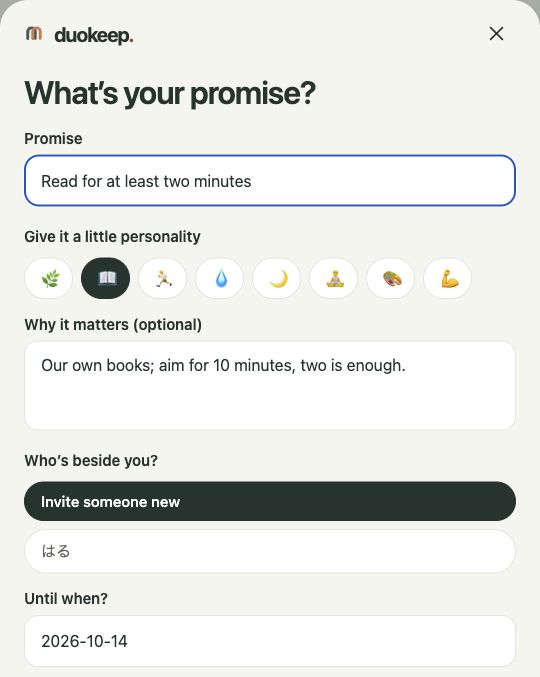
After reading, open Today’s check-in, choose I did it, and optionally note the amount and where to resume. Keep the note short enough that logging does not become another task. For a paper book, the bookmark still holds the exact place.
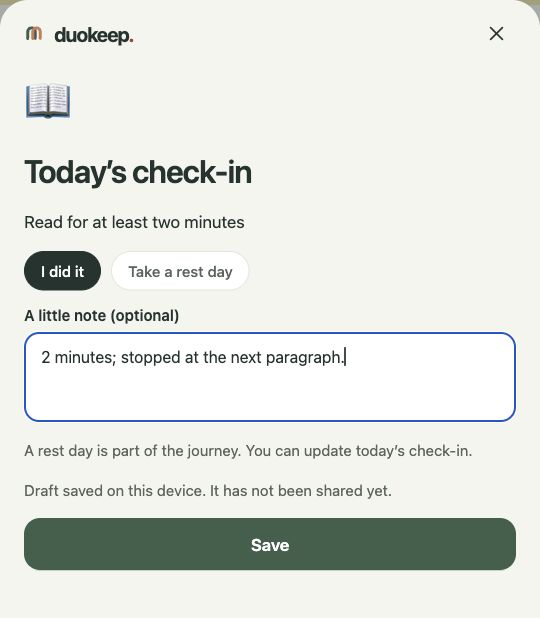
Each person reports for themselves. Your completion does not complete your friend’s session. DuoKeep’s shared streak increases when both people are Done for the same goal day; the goal uses its creator’s timezone. In this example that is Asia/Tokyo, as shown on the setup screen. If you live in different timezones, agree on that shared cutoff before relying on the daily streak.
DuoKeep does not measure how long you read or automatically distinguish the minimum from the longer aim. The report is your own account of what you did. A notebook or a short message can serve the same basic reporting purpose.
What should you do when you miss a day?
Return at the next workable reading cue without adding a catch-up debt. If the same obstacle repeats, change the plan that caused it. You can keep your previous reading record even when a streak ends.
If you are too tired at bedtime, try an earlier cue. If choosing a book consumed the session, leave one book ready the night before. If the book makes you avoid reading, switch to something you want to open and keep the same small action. You can return to the first book later.
If the cue keeps disappearing or you remember only later, our habit stacking guide shows how to compare the cue with a week of actual reports before choosing a different pairing.
A two-minute session counts under the example rule. Zero reading does not. Use Take a rest day to report a day without completing the action, with a note if useful. An empty report only tells your friend that no report was saved, so ask once rather than assuming you know whether they read.
A shared streak can end when a completed goal day lacks both Done reports. That app counter is not a scientific measure of whether you have lost a habit. In Lally and colleagues’ habit-formation study, one missed opportunity did not materially disrupt the process. The study followed eating, drinking, and activity behaviours, not reading, so it cannot give you a reading-specific recovery guarantee or deadline.
Review the cause, then change one thing
Look at when you started and what got in the way before increasing the target. Minutes alone can hide a bad cue, a disliked book, or a record that takes too much effort.
These four fictional entries use the same two-minute rule. They illustrate decisions you could make; they are not records from the preview or observed improvements.
| Example report | Interpretation | Next adjustment |
|---|---|---|
| Maya: “10 minutes after breakfast; bookmark in place.” | The cue and book suited this day. | Keep the same setup for now. One good day does not require a higher minimum. |
| Leo: “Rest day; dinner ran late and I was too tired.” | The evening cue did not leave a usable slot. | Try reading before dinner, or another recurring event that fits. |
| Maya: “2 minutes; I keep avoiding this book.” | She met the rule, but book choice may be blocking a longer session. | Try a different book while keeping the cue and minimum. |
| Leo: “12 minutes; I wanted to keep reading.” | The longer session was optional. | Keep it optional. Do not raise both people’s minimum from one longer day. |
At the October 15 review, Maya and Leo would decide which cue and book to keep, whether the two-minute minimum still fits, and whether they want another period together. They can stop the shared arrangement while continuing to read separately.
If a reply or reminder is the difficult part, clarify the exchange using our accountability partner roles guide and fillable agreement. If you mainly need a different kind of tool, compare shared habit trackers by how they record progress.
Common reading habit questions
How many minutes should I read each day?
Start with an amount that fits a real repeatable slot. Ten minutes with a two-minute minimum is one suggested trial, not a universal prescription. A slow or demanding book may make pages a poor measure of effort, so minutes can be a simpler starting unit.
Do ebooks and audiobooks count?
For a personal leisure-reading goal, you can choose to include both. If you share the routine, say whether listening counts and record listening minutes rather than converting them to invented page totals. For assigned reading or studying, follow the task’s requirements instead.
How long does it take to make reading a habit?
There is no deadline established by the study cited here for reading. That study found substantial variation across other behaviours, with modelled times from 18 to 254 days. Use an early review to fix the routine, then keep reviewing as needed. Finishing a seven-day or thirty-day plan does not prove automaticity.
Should we compete on books or pages finished?
Only if both people want that game and understand the comparison. A short novel, a dense history book, and an audiobook involve different units. For the routine above, each person’s honest completion report matters more than winning a page total.
For your next session, choose the book, name the cue, and write the minimum. If a friend has agreed to the same daily rule and you want to see both reports in one place, set up that one goal in DuoKeep.
For other routines, our daily habits to track and rule builder helps you choose an action, a cue and the kind of record it needs.
DuoKeep · Habits for two
One goal. Two people.
Start together.
Build a daily habit with a friend or partner. Each person checks in separately, and each pair gets one active goal free.
Free to start. DuoKeep Plus is optional. Store availability and purchase prices vary by country.
More habit guides
Browse our habit guides for choosing an app and planning a goal together.
Habit guide
Goal Tracker Apps: 5 Options by What You Need to Record
Choose a goal tracker app for finished results, assigned tasks or two daily reports. Compare five options, free limits and sharing conditions.
Read the guide
Habit guide
Apps for Couples: Questions, Calendars and Daily Habits
Choose among five apps for couples by the result you want to share, both partners’ access, free limits and the first thing to check together.
Read the guide