Habit Stacking: Examples and a Plan That Fits Your Day
Habit stacking means attaching a new action to a routine you already do: after one specific event, do one clear action. Choose a cue that actually happens on your planned days, leaves room for the action, and has an endpoint you can notice. Then record where the sequence worked or stopped.
Use the examples and fill-in plan to choose your first pairing. The seven-day sketching example shows how to tell a missing cue, a partial attempt and a late completion apart. You can start on your own; a partner is optional.
Published by MYOHO Group LLC, the developer of DuoKeep. Product rules were checked on October 9, 2026. The plans and reports below are proposed examples, not customer trials or a test of when a habit becomes automatic. See how we write our guides.
What habit stacking means
A habit stack links an existing routine to the action you want to add. James Clear describes the pairing as a specific cue for a new habit and credits BJ Fogg’s Tiny Habits approach. The useful planning question is concrete: what do you already do that can tell you when to begin?
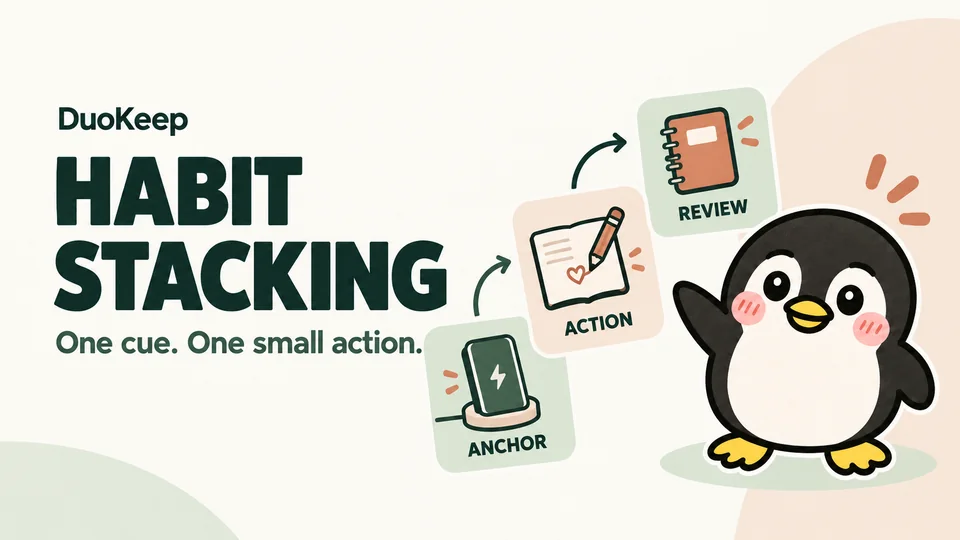
Write it as “After I [finish a specific existing action], I will [do a clear new action].” For example: after placing your phone on its evening charger, sketch in a notebook for two minutes. Charging is the cue; sketching is the action. Putting the notebook nearby is preparation.
Stacking is a sequence, rather than doing two activities at once. Start with one new action so you can inspect the pairing. A long chain is harder to diagnose if you cannot tell which step stopped. This is a practical starting choice, not a fixed scientific limit.
Choose an anchor that occurs in your real week
Choose from events you already perform, then check their actual frequency, endpoint and conditions. A workday cue can fit a workday habit. It cannot provide a daily opportunity on days when you do not work.
- Occurrence: Did this event happen on the days you want to practise? Look back at your recent week instead of assuming that breakfast, a commute or a meeting happens every day.
- Endpoint: Can you identify the moment? “After I plug the phone into its evening charger” is clearer than “sometime tonight.”
- Room: Are you in a place where the action is possible, with the time and materials it needs? A good reminder does not create an empty two-minute slot.
- Frequency: If the event occurs several times a day, specify which occurrence you mean. “After the first work session” describes a different plan from “after every work session.”
For Nora’s proposed daily sketching habit, closing a work notebook is unsuitable on weekends. She chooses evening charging because it occurred at home on the days she reviewed. That choice is a starting hypothesis. If charging moves to a train or disappears on a trip, she will need a different plan.
If no existing event fits, use a scheduled session or a visible reminder instead. You do not need to turn every routine into a stack. For help choosing the action and record format first, see our daily habit ideas and rule builder.
Six habit stacking examples to adapt
Use these as possible pairings. The conditions matter as much as the sentence: some fit daily practice, others fit only selected sessions or trips. The amounts are starting examples you can change before you begin.
| Example stack | Check the opportunity | Prepare before the cue |
|---|---|---|
| After I put my phone on its evening charger, I will sketch for two minutes. | Use this only if charging happens where you can sit and draw. Decide which evening charge counts. | Keep a pencil and open notebook beside that place. |
| After I finish my first planned writing session, I will note one question to answer next time. | This is a session-based action. A day without that session is not automatically a failed day. | Leave a space for the question at the end of your draft. |
| After I put my lunch plate in the sink, I will read one paragraph of the essay I chose. | Check that the break still has room and the text is available. Do not assume every meal ends at home. | Save or print the essay before lunch. |
| After I put away my instrument, I will name the passage to practise next. | Use a real practice session as the cue. This plans the next session; it does not count as practising it. | Keep a small next-session card in the instrument case. |
| After I check tomorrow’s calendar, I will place the item I need first beside my bag. | Decide what the item is and whether tomorrow needs one. If none is needed, record the check honestly. | Choose one place for the bag and the calendar note. |
| After I return home and put my transit card away, I will review two saved vocabulary cards. | A commute-only cue needs a commute-day schedule or a separate cue for home days. | Keep the two cards where the transit card goes. |
Write one plan before your next attempt
Write the cue, completion rule, planned days and observation you want to keep. You can copy this structure into a note or write it beside your tracker. Recording how you started is optional, but useful when you are testing the cue.
- Cue: After I ____________________, I will begin.
- Action and completion rule: I will ____________________.
- Planned days or occasions: ____________________.
- Place and preparation: ____________________.
- If the cue is absent: I will use ____________________, or record that the planned opportunity did not happen.
- After the attempt: note whether the cue occurred, whether you noticed it, and what you actually did.
- Review date: ____________________.
Nora’s plan is to sketch for at least two minutes after her evening phone charge, every day for the next week. Her notebook and pencil will be beside the charger. If the usual charge does not happen, she can sketch at a separately chosen evening time and label that as a later start. The two-minute rule stays the same.
A smaller attempt can still be worth recording. One minute is partial work under this two-minute rule, rather than a completed two-minute action. If Nora decides that one minute is the new rule, the change applies to future attempts; it does not rewrite older reports.
Read the cue and the action separately
A completion mark tells you whether the action rule was met. It does not tell you that your chosen cue started it. Keep those observations separate when deciding what to change.
Here is a fictional week under Nora’s unchanged two-minute sketching rule. All seven days were planned. The notes record her account of what happened, rather than a sensor or an automaticity measure.
| Day | Cue observation | Action report |
|---|---|---|
| Monday | Evening charge happened; she noticed it. | Sketched for two minutes immediately after it. Complete. |
| Tuesday | Evening charge happened; she noticed it. | Started then, but stopped at one minute. Partial. |
| Wednesday | The usual evening charge did not happen. | She confirms that she did not sketch. Known miss. |
| Thursday | Evening charge happened; she did not notice it as the cue. | Remembered later and sketched for two minutes. Complete, with a later start. |
| Friday | Evening charge happened; she noticed it. | Sketched for two minutes immediately after it. Complete. |
| Saturday | Evening charge happened; she noticed it. | Sketched for two minutes immediately after it. Complete. |
| Sunday | No cue observation was recorded. | No action report. Unknown. |
There are four confirmed completions: Monday, Thursday, Friday and Saturday. Three followed the chosen cue; Thursday happened later. Tuesday adds one partial attempt, Wednesday one confirmed miss, and Sunday one unknown result. Do not turn the blank Sunday into a guessed failure or success.
These reports do not establish that the cue caused the action or that sketching became automatic. They do identify questions Nora can answer before changing the whole habit.
| Example report | Interpretation | Next adjustment |
|---|---|---|
| The cue did not occur on Wednesday. | The proposed daily opportunity was absent. | Choose a cue that fits those days, write a backup, or change the planned schedule. |
| Thursday was complete, but started later. | The action happened; the chosen pairing was not what prompted that start in her account. | Make the endpoint or notebook easier to notice, or test the later moment as the next cue. |
| Tuesday started on cue and stopped at one minute. | Remembering was not the only issue. The amount or available time may need review. | Ask what interrupted the attempt. Adjust future amount or slot if needed; retain the original partial report. |
| Sunday has no report. | You lack the result and the cue observation. | Clarify the report if Nora wants to. Do not diagnose motivation from missing data. |
At the chosen review date, keep a pairing that fits, or change the specific part the notes call into question. Seven days is a convenient observation window here, not a pass score or a deadline for habit formation. Our habit-review guide explains why a streak cannot establish automaticity.
Two people can share an action and use different cues
Two willing partners can agree on the same completion rule without having the same routine. Mika might sketch after charging a phone; Lee might sketch after putting away dinner cutlery. Each cue must fit that person’s actual day. Neither person’s sketch completes the other person’s action.
For a common daily rule such as “Sketch for at least two minutes,” DuoKeep provides separate check-ins on one shared goal. Write the personal cues in the reason or your own planning note, agree on reminders you both want, and check the displayed goal time zone. The app does not detect charging or dishwashing, and a reminder is not evidence that the cue occurred.
- Create the shared goal with the unchanged two-minute completion rule and a deadline both people want. Invite the other person with the code or QR code.
- After actually sketching for two minutes, each person records their own I did it. A brief note can say whether they started after the cue or later.
- For a one-minute attempt, keep the partial amount in the note. DuoKeep has Done and Rest day reports, not a separate partial-progress category. If you use Rest day for a non-complete attempt, explain the difference in the note.
- An absent report remains unknown. A completed shared-streak day requires both people’s Done reports on the same goal date; a rest or an ended day without both completions does not add that day.
Each pair gets one active goal free, on iPhone or Android. This is a proposed setup using the developer’s checked product rules, not a two-person sketching trial. Choose DuoKeep when the shared daily record is what you want to add to your plan.

DuoKeep · Habits for two
One goal. Two people.
Start together.
Build a daily habit with a friend or partner. Each person checks in separately, and each pair gets one active goal free.
Free to start. DuoKeep Plus is optional. Store availability and purchase prices vary by country.
If you want different actions, selected weekdays, numeric summaries or a solo log, keep a format that supports them. The Google Sheets habit tracker supports quantities and planned weekdays; the paper tracker gives you a dated record. Neither automatically observes your cue. Keep a short start note alongside the amount if that is the question you are testing.
Questions about habit stacking
What if the anchor happens only on workdays?
Either plan the new action for workdays or choose a separate cue for the other planned days. Do not treat a missing commute as evidence that you ignored a cue. A daily shared goal needs an opportunity that fits each person’s daily plan.
How many habits should I put in a stack?
For the first attempt, add one new action. After reviewing whether the pairing fits, decide whether another action would serve a useful purpose and fit the same opening. There is no universal number established by this guide.
Should I restart after missing one day?
Choose the next wanted attempt and record what happened under the original rule. A missed day does not remove earlier work. Inspect whether the cue, materials, amount or reporting caused the difficulty; do not require a larger catch-up session just to repair a counter.
Does habit stacking need an app?
No. A note beside the cue can hold the plan. Use a tracker when its record answers a question you care about. An app reminder can be useful support, but it does not make the action automatic or supply a suitable place to do it.
Sources and how we built this guide
We read James Clear’s explanation, Griply’s anchor audit, DailyHabitAI’s builder, Xenith’s examples and HabitScaler’s practical guide. They already offer useful cue checks, examples and repair advice. We wrote the proposed plan and matching seven-day record to connect those decisions to observable reports, including a conditional two-person setup.
DuoKeep’s public product page and the developer’s goal, report and shared-date implementation support the product description. We did not measure lasting habits or app results from these examples. If you already have a partner and both want the same daily action, you can keep your individual reports together in DuoKeep.
DuoKeep · Habits for two
One goal. Two people.
Start together.
Build a daily habit with a friend or partner. Each person checks in separately, and each pair gets one active goal free.
Free to start. DuoKeep Plus is optional. Store availability and purchase prices vary by country.
More habit guides
Browse our habit guides for choosing an app and planning a goal together.
Habit guide
Goal Tracker Apps: 5 Options by What You Need to Record
Choose a goal tracker app for finished results, assigned tasks or two daily reports. Compare five options, free limits and sharing conditions.
Read the guide
Habit guide
Apps for Couples: Questions, Calendars and Daily Habits
Choose among five apps for couples by the result you want to share, both partners’ access, free limits and the first thing to check together.
Read the guide