Free 30-Day Habit Tracker Printable: Solo or With a Friend
Download a free 30-day habit tracker printable in A4 or US Letter. Each PDF includes a one-person page and a two-person page for one written habit rule. For calendar dates or selected weekdays, use the dated builder below.
Download the blank 30-day PDFs
Both files are free for personal use, with no signup or required app install. Print page 1 for yourself or page 2 for two separate reports. You can also fill and save the fields in a PDF reader that supports forms.
Day 1 means your start date. The blank PDFs have 30 day-numbered cells; you add the start date and plan yourself. To print actual dates, including a 31-day month, create a dated record.
Published by MYOHO Group LLC, the developer of DuoKeep. Product details and resources were checked on October 9, 2026. The filled reading week is a fictional example.
Create a dated paper record
Use a calendar month or start a 30-day record on any date. One written rule applies to the whole sheet. With two people, each keeps their own report.
In the print view, choose Print or save as PDF. Pick the same paper size there. Your entries are not saved by this tool. Printing creates a paper record, with no reminders or live sync.
Preview your dated record
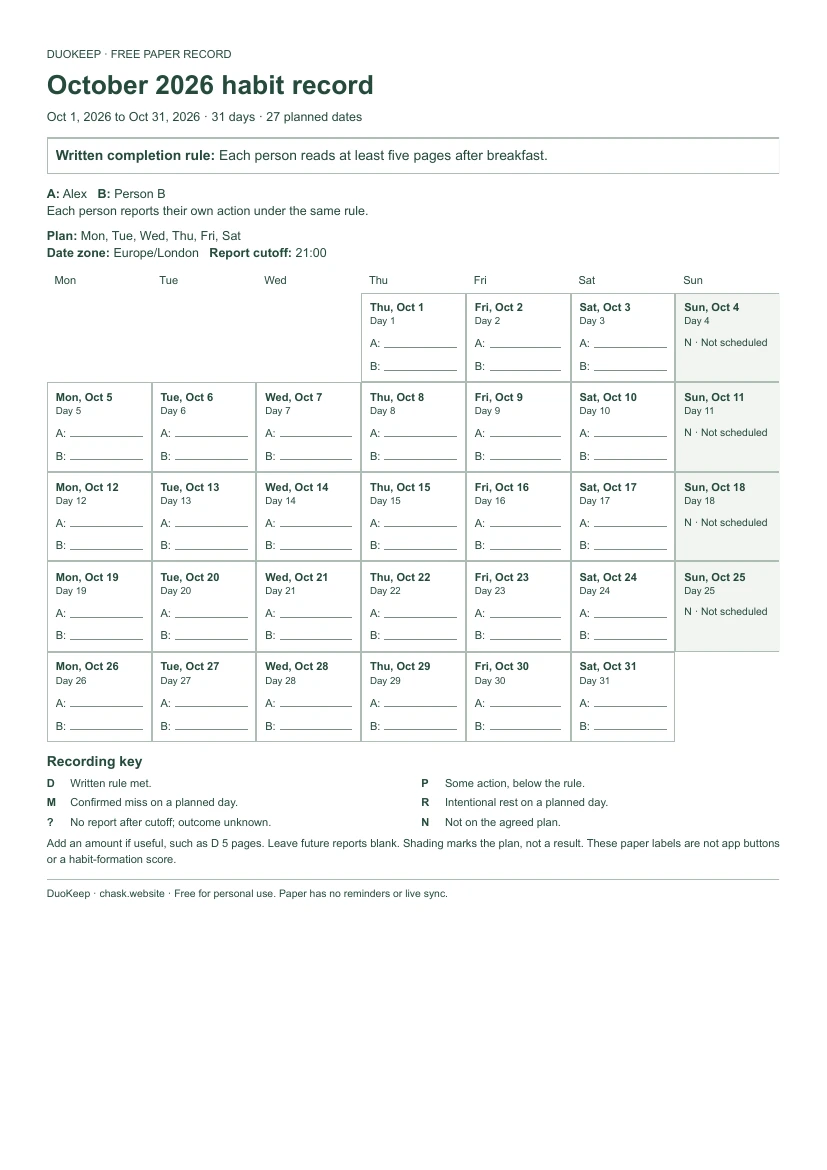
Open the preview to check your dates before printing. The builder shades unplanned weekdays and leaves planned report lines empty. A month follows its real length; a 30-day record can continue into the next month or year.
Write one rule, a plan and a reporting time
Write an action with a clear completion rule before filling the cells. Include an amount when it changes what counts, such as five pages, one practice exercise or two minutes of tidying.
Choose the dates you intend to act and when you will record the result. A date zone is useful if two people live in different places: agree which date labels both of you will use. The builder prints that zone as a label; it does not convert either person’s local time.
Each person reads at least five pages after breakfast. Day 1 is October 12, 2026. We plan Monday to Saturday, use Europe/London dates, and report by 21:00 in that zone.
This proposed reading plan uses the two-person page. For a solo page, write “Read at least five pages after breakfast.” If you need an action to start with, use our habit ideas and rule builder; for choosing a book and cue, see the reading habit guide.
Record a week without turning every gap into a miss
Use the printed recording key: D for meeting the rule, P for a partial attempt, M for a confirmed miss on a planned day, R for an intentional rest on a planned day, ? for no report after the cutoff, and N for an unplanned day. Add an amount if it helps, such as D 5 pages.
Leave future dates blank. Before the reporting cutoff, an empty cell can simply mean that the day is still open. After the cutoff, an absent report leaves the outcome unknown until the person confirms it.
| Day | Alex’s report | Sam’s report |
|---|---|---|
| 1 · Mon, Oct 12 | D 5 pages | P 2 pages |
| 2 · Tue, Oct 13 | R | D 5 pages |
| 3 · Wed, Oct 14 | M 0 pages | D 5 pages |
| 4 · Thu, Oct 15 | ? | D 7 pages |
| 5 · Fri, Oct 16 | D 6 pages | M 0 pages |
| 6 · Sat, Oct 17 | D 5 pages | D 5 pages |
| 7 · Sun, Oct 18 | N | N |
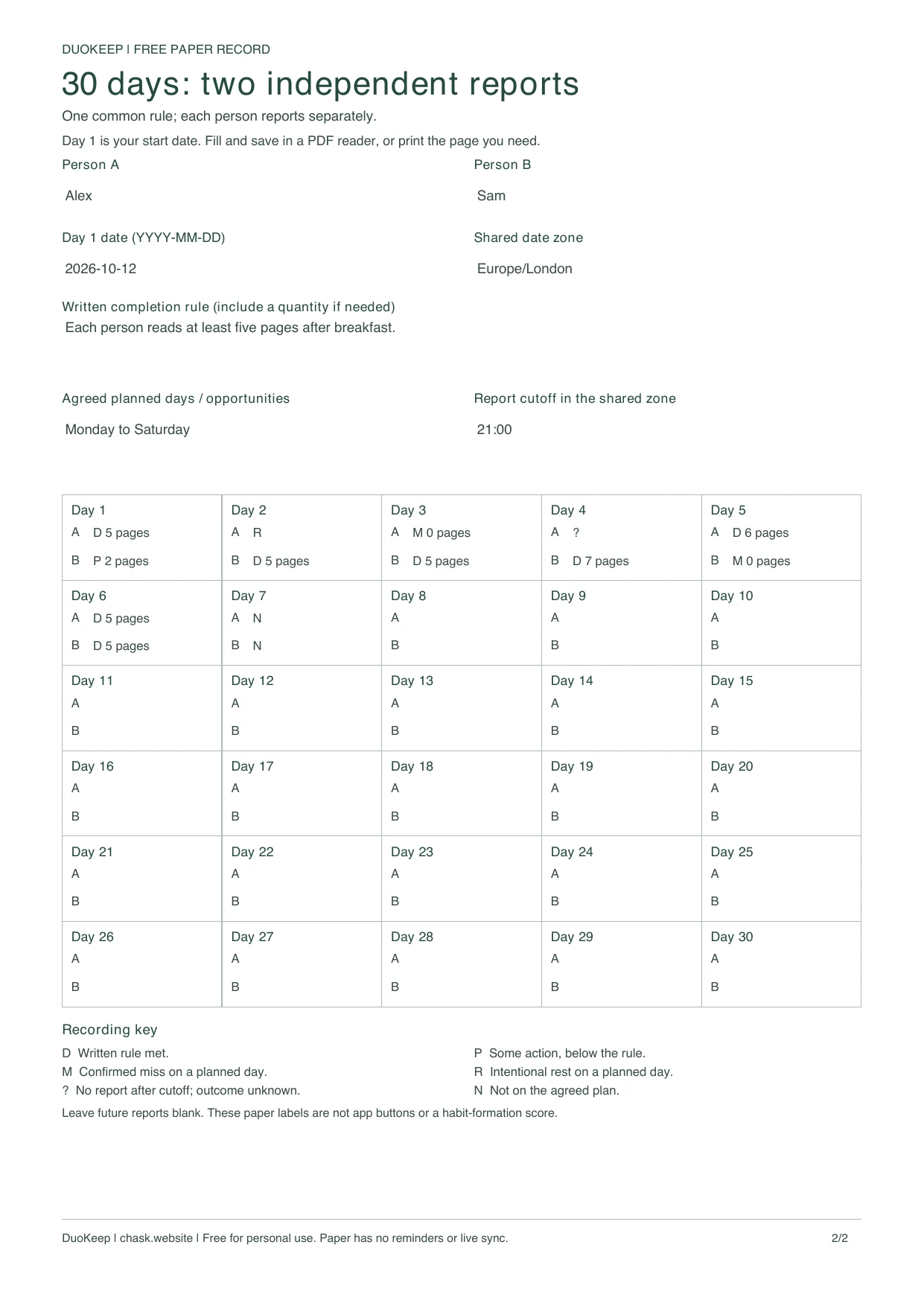
On day 1, Alex met the five-page rule while Sam read two pages. Record both amounts. Sam’s P preserves the attempt without treating two pages as five.
Alex’s R on day 2 records a chosen rest; M on day 3 records a confirmed missed action. On day 4, ? means the reporting time passed without Alex’s report. Ask what happened before changing it to D, P, M or R. Sam’s own report stays D 7 pages.
Sunday was outside the plan, so both cells are N. Alex has three recorded D days and Sam has four. Both met the rule on day 6 only. Count each person’s record separately and keep the unknown report visible.
At the review, ask whether the action, timing or reporting needs changing. If five pages repeatedly feels too much, agree on a new rule for the next sheet. Keep the old sheet under its original rule and plan so that earlier reports retain their meaning.
Use two independent reports with a friend
Choose the second PDF page or “Two independent reports” in the builder when both people want the same written rule. Each person fills their own A or B line. One person’s D leaves the other person’s result to be reported.
You can use different books while following the same five-page rule. If one person wants reading and the other wants walking, use separate sheets with separate rules. One common-rule page would make those records difficult to interpret.
Paper has no live sync. Agree whether you will use the same physical sheet, send a photo, or keep separate copies and review them together. If you have not chosen a partner, the accountability partner guide covers finding and agreeing with one.
Choose paper, Google Sheets or a paired app
Choose the format that matches what you need to record. Paper is enough for handwritten reports. Use Sheets for numeric amounts and summaries, or a paired app for a shared daily goal on your phones.
| Your situation | Start with | Check before you choose |
|---|---|---|
| You want a printable record, including selected weekdays | The free PDFs or dated builder | One written rule per sheet; record and review by hand. Sharing needs a physical copy, photo or agreed exchange. |
| You want monthly quantities and automatic summaries | The free Google Sheets tracker | Make your own copy while signed in to Google. It supports one numeric rule, planned weekdays and optional second-person reports. |
| You already have a partner and want one common daily action | DuoKeep | Each person reports separately. A shared-streak day needs both Done reports on the same goal date. |
| You want several unrelated habits or different sharing rules | The habit tracker app fit guide | Compare recording units, schedules, visibility and device requirements before choosing an app. |
When DuoKeep fits a daily plan
Use DuoKeep when you already have a friend or partner and both want to repeat one common action each day. Its official App Store description explains separate daily check-ins, notes, optional reminders and one active goal free per pair. Plus is optional; your store shows local purchase terms.
DuoKeep records Done, Rest day and unreported states. The paper’s P, M, ? and N labels are worksheet conventions, rather than additional app check-in options. Each person decides whether they met the agreed rule and submits their own report.
The app’s shared streak counts dates when both people reported Done. It uses the goal’s date zone, retained from the creator’s device when the goal was created. If your plan excludes Sundays and you want those dates automatically ignored, keep the paper or Sheets schedule instead of treating a daily shared streak as that schedule.

DuoKeep · Habits for two
One goal. Two people.
Start together.
Build a daily habit with a friend or partner. Each person checks in separately, and each pair gets one active goal free.
Free to start. DuoKeep Plus is optional. Store availability and purchase prices vary by country.
Printing and common questions
Choose A4 or US Letter to match your paper. In the dated print view, select portrait, start at 100% scale, and turn off browser headers and footers. If an edge is clipped, try Fit to printable area. For the blank PDFs, print only the solo or two-person page you need.
What if the print view does not open?
A browser may block a new print tab or handle printing differently inside an app. Try the page in your normal desktop browser. You can use the blank PDFs directly if the dated print view remains unavailable.
Can I type into the PDFs?
The blank downloads contain fillable fields. Use a PDF reader that supports forms, save a separate copy, then reopen it to check that your entries remain. If your reader only displays the file, print it and write by hand.
What is the difference between a month and 30 days?
A calendar month includes every date in that month, including 28, 29, 30 or 31 days. The rolling option always includes 30 dates, starting with the date you choose. For example, December 15, 2026 through January 13, 2027 is 30 dates including both ends.
Can I use one printable for several habits?
These sheets use one rule. Use a separate page for each unrelated habit, or choose a multi-habit format through the app fit guide. The two report lines on the pair page belong to two people following the same rule.
What should I do after 30 days?
Review what you actually recorded, including partial attempts, rest and missing reports. Choose whether to keep the action, change its cue or rule, or stop it. Start a fresh sheet for the next period. The 30 days define this record’s length; they do not establish that your habit has become automatic. Our habit-plan review offers examples of adjustments.
Resource checks and product details
We checked the blank and fictional filled PDF pages, saved dated A4 and US Letter output from desktop Chrome, and checked the builder at narrow and desktop widths. Physical printing, mobile Safari and manual form entry in a PDF reader have not been tested. The illustrated cover is separate from the actual record images.
DuoKeep details use the official iPhone listing and developer-checked report, streak and date rules. Check the Android listing for installation availability. The supplied sheets and example reports were created for this guide. See how we write these guides.
For one common daily goal with an existing partner, you can move from handwritten reports to separate check-ins in DuoKeep. Agree on the rule and goal date before starting.
DuoKeep · Habits for two
One goal. Two people.
Start together.
Build a daily habit with a friend or partner. Each person checks in separately, and each pair gets one active goal free.
Free to start. DuoKeep Plus is optional. Store availability and purchase prices vary by country.
More habit guides
Browse our habit guides for choosing an app and planning a goal together.
Habit guide
Goal Tracker Apps: 5 Options by What You Need to Record
Choose a goal tracker app for finished results, assigned tasks or two daily reports. Compare five options, free limits and sharing conditions.
Read the guide
Habit guide
Apps for Couples: Questions, Calendars and Daily Habits
Choose among five apps for couples by the result you want to share, both partners’ access, free limits and the first thing to check together.
Read the guide