Free Goal-Setting Worksheet: Plan, Act and Review
Use a goal-setting worksheet to name the result you want, decide how you will recognize it, and plan the actions you can repeat. Keep a review date as well as a deadline so you can check what changed before the deadline arrives.
The free two-page PDF below separates your goal plan from your review. Page 1 holds the result, action, timing and first step. Page 2 compares result evidence with action reports. Use it on your own or keep a separate copy for each person.
Free, two pages, 17 fillable fields, no signup. Choose the paper size your printer uses. You can type in a PDF reader that supports forms or print and write. For a filled example, download A4 or US Letter.
Published by MYOHO Group LLC, the developer of DuoKeep. Product rules were checked on October 9, 2026. The writing plan and reports are fictional examples. We checked the supplied PDFs by filling, saving, reopening and rendering them; these are file checks, not customer results. See how we write our guides.
Fill page 1 with one goal you can review
Start with one result and a way to inspect it. A general wish can be useful direction, but the worksheet needs a next step you can take and a question you can answer at the review.
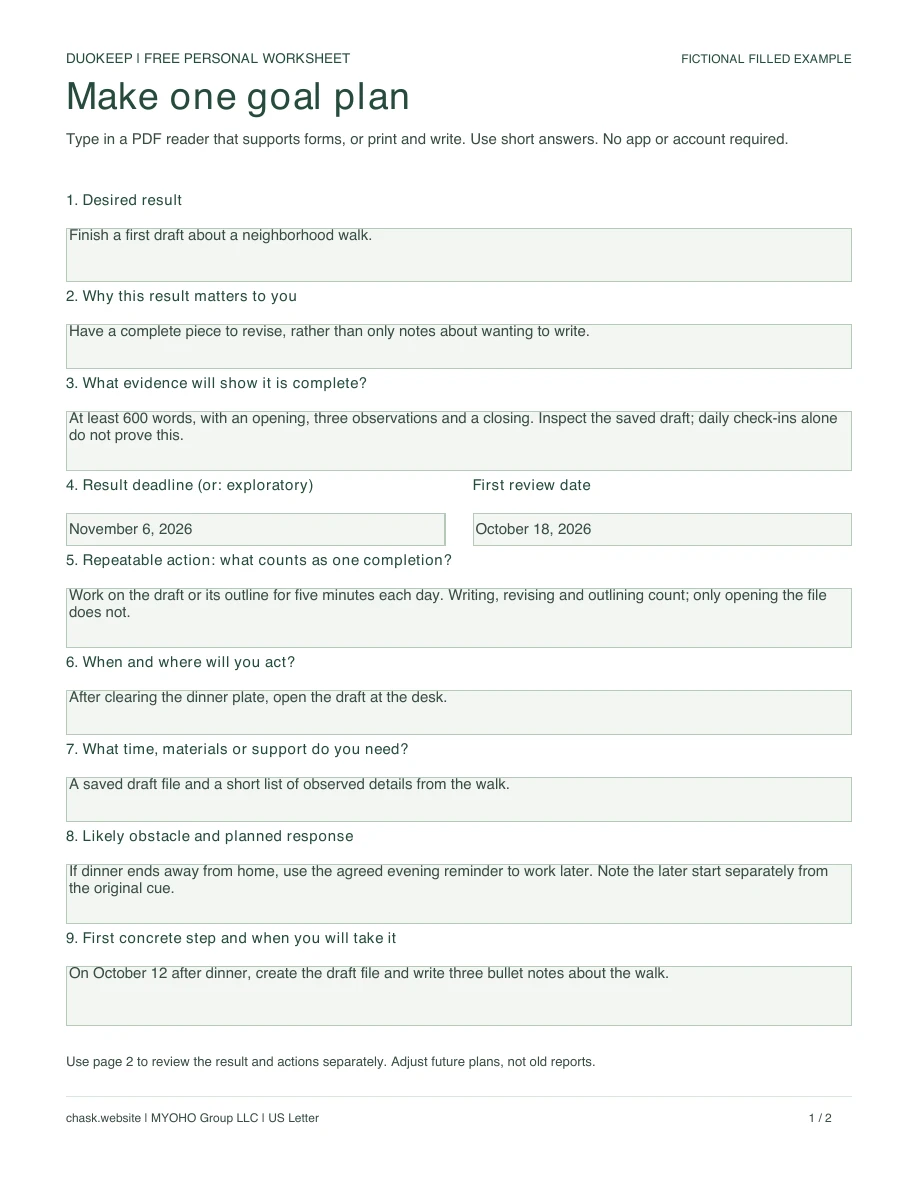
Here is a fictional plan for a first draft about a neighborhood walk. Its 600-word minimum and five-minute work block are chosen example rules, not research thresholds. The result is a complete first draft; the daily action is work on the draft or its outline.
| Worksheet field | Fictional answer |
|---|---|
| 1. Desired result | Finish a first draft about a neighborhood walk. |
| 2. Reason | Have a complete piece to revise, rather than only notes about wanting to write. |
| 3. Completion evidence | At least 600 words, with an opening, three observations and a closing. Inspect the saved draft for all of these. |
| 4. Deadline and first review | Result deadline: November 6, 2026. First review: October 18, 2026. |
| 5. Action rule | Work on the draft or its outline for five minutes each day. Writing, revising and outlining count; only opening the file does not. |
| 6. When and where | After clearing the dinner plate, open the draft at the desk. |
| 7. Resources | A saved draft file and a short list of observed details from the walk. |
| 8. Obstacle and response | If dinner ends away from home, use the agreed evening reminder to work later. Record that later start separately from the original cue. |
| 9. First step | On October 12 after dinner, create the draft file and write three bullet notes about the walk. |
Write enough detail to answer “What would count?” A 600-word file with no closing does not meet this plan’s completion rule. A five-minute outlining session can meet its action rule even when the draft’s word count stays unchanged. Editing can reduce the count.
Check the available time before treating the deadline as fixed. If you have not attempted this kind of task before, use the first review to reassess the amount and steps. The five-minute block provides a starting action here; it does not guarantee a finished draft by November 6.
If you cannot yet define the result, write an exploration step instead: collect three possible topics, compare them on your review date, then choose a draft. You can mark the deadline field as exploratory. For choosing a repeatable action first, use our daily habit ideas; for connecting it to an existing event, see habit stacking.
Preview the fictional filled plan page
Use the SMART checks to find a missing part
For personal goals, SMART commonly means Specific, Measurable, Achievable, Relevant and Time-bound. Use those words to check the plan, rather than as a success score. Vertex42’s SMART worksheet also combines a goal with steps and measurement; the acronym alone is not the whole plan.
| SMART check | Question for this plan | Answer or next check |
|---|---|---|
| Specific | What will exist? | A first draft about a neighborhood walk, with the stated sections. |
| Measurable | What will show completion? | The saved draft meets the word minimum and includes all required parts. Count the daily actions separately. |
| Achievable | Do the steps fit the time, skill and materials available? | There is a file, observed detail and a chosen work slot. Reassess the scope at the first review; feasibility is not proven by filling the sheet. |
| Relevant | Why do you want this result? | It gives the writer a complete piece to revise. Choose your own reason instead of borrowing that one. |
| Time-bound | When will you inspect progress and the result? | Review October 18; aim to finish November 6. A review and a deadline answer different questions. |
If the outcome depends on another person, choose an action you can carry out and inspect. Sending a carefully prepared proposal and receiving a positive reply are different events. Record the actual reply when it arrives; do not mark it complete because you sent the proposal.
Some goals describe an ongoing direction, such as making time for creative work. You can plan the next concrete action without forcing that direction into a final finish date. The Psychology.com worksheet also explains this limitation. This guide uses an everyday writing example, not a medical or therapeutic plan.
Review the result and the action reports separately
On the review date, open the actual work and compare it with the completion conditions. Then read the action reports. Those two checks may give different answers.
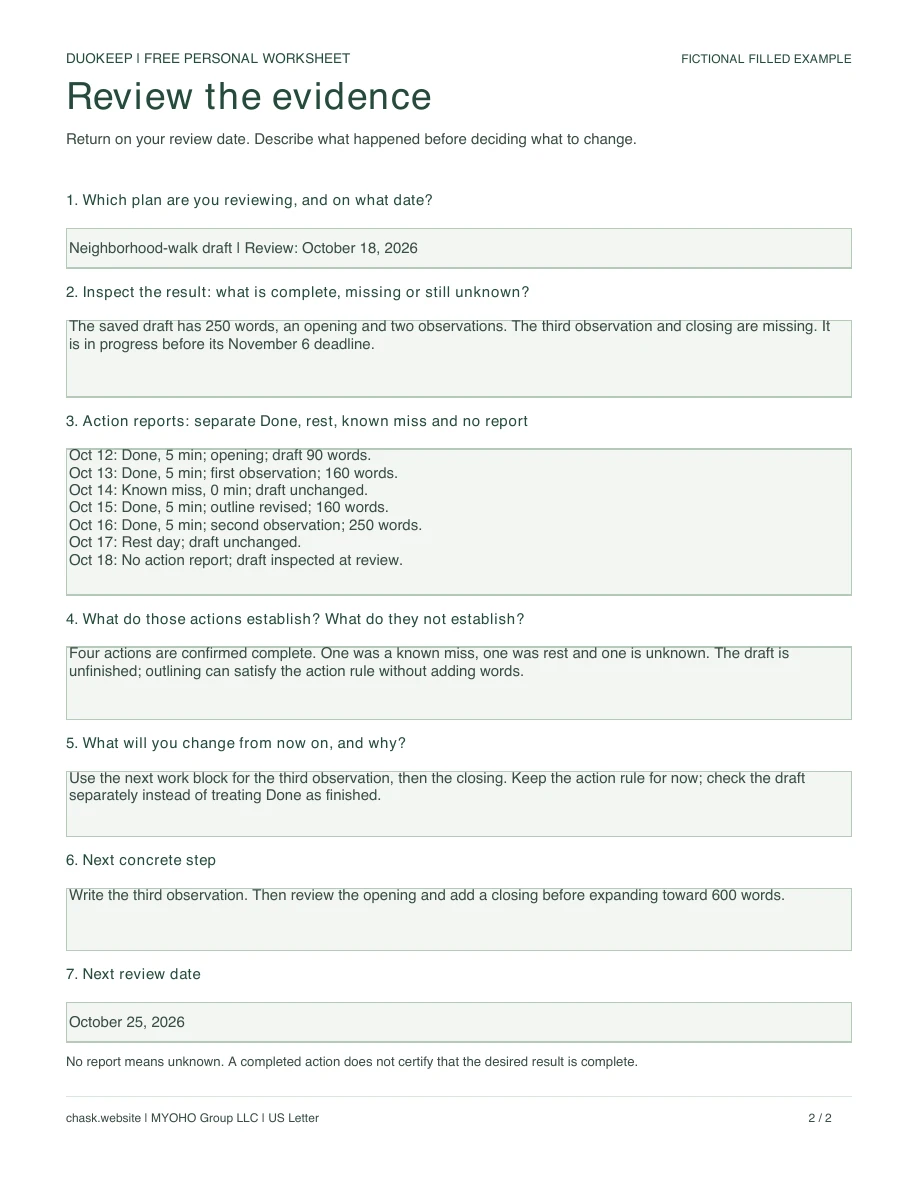
In this fictional October 12–18 record, the five-minute action rule is unchanged. “Known miss” means the writer confirms no work happened; “unknown” means there is no action report. The draft can still be inspected at the review even when that day’s action is unknown.
| Day | Action report | Draft evidence |
|---|---|---|
| October 12 | Done: five minutes. | Opening written; 90 words. |
| October 13 | Done: five minutes. | First observation added; 160 words. |
| October 14 | Known miss: zero minutes. | Draft unchanged. |
| October 15 | Done: five minutes outlining. | Outline revised; draft still 160 words. |
| October 16 | Done: five minutes. | Second observation added; 250 words. |
| October 17 | Explicit rest day. | Draft unchanged. |
| October 18 | No action report: unknown. | At review, the saved draft has 250 words. |
Result check: the 250-word draft has an opening and two observations. It still needs the third observation, a closing and more words. It is in progress before the November 6 deadline. The review does not turn an unfinished draft into a completed result.
Action check: four actions are confirmed complete, alongside one known miss, one rest report and one unknown. October 15 met the outlining rule without adding words. Do not turn the missing October 18 report into a guessed zero, or change older Done reports because the draft remains unfinished.
Complete the rest of page 2 from those observations: the next work block will address the third observation, then the closing. Keep the five-minute action rule for now and inspect the draft again on October 25. That is the example’s next decision, not proof that this adjustment will produce the finished piece.
Preview the fictional filled review page
Change a future plan when the evidence gives you a reason. If the action happens regularly but misses an essential task, change the next step. If the slot rarely exists, change the slot or schedule. If reports are missing, clarify them before diagnosing why the work stopped. Smartsheet’s planning templates already distinguish leading actions from later results; our example makes that distinction visible in one matching record.
Want to keep this plan in an app? Compare goal tracker apps for result totals, assigned tasks and daily reports. Choose the record your next update needs to change, then check the plan limits and sharing access.
Use a separate worksheet for each person
With a partner, keep each person’s result and acceptance conditions on their own sheet. Agree on the kind of support you want: seeing action reports, replying, or giving feedback on the work. Those are different roles; a shared check-in does not supply editing or certify a finished draft.
For two known people who both want a daily five-minute writing or outlining block, DuoKeep can keep the separate check-ins on one shared goal. Their topics and completion conditions can differ while the daily action rule stays the same. Each person checks their own result in their worksheet.
- Use the shared goal title “Work on my draft or outline for five minutes.” Keep each draft’s acceptance conditions and review dates on the separate worksheets. Choose an app goal deadline both people want.
- Invite the other person with the code or QR code. Agree on wanted reminders and check the displayed goal time zone.
- After five minutes of the agreed work, each person records their own I did it. A note can say “outline revised; no new words” so a Done report is understandable.
- Use an explicit rest report for a rest day. A non-complete attempt needs an honest note; the app has Done and Rest reports, not the worksheet’s separate known-miss category. An absent update remains unknown.
One active goal per pair is free; Plus is optional. This is a proposed setup checked against the public App Store description and the developer’s current goal/report rules, not a live two-person writing trial. DuoKeep does not inspect the draft or verify its word count and sections. Choose it when both people want that common daily action record.

DuoKeep · Habits for two
One goal. Two people.
Start together.
Build a daily habit with a friend or partner. Each person checks in separately, and each pair gets one active goal free.
Free to start. DuoKeep Plus is optional. Store availability and purchase prices vary by country.
If you want different action rules, quantities or selected weekdays, keep a record that fits those requirements. Our Google Sheets habit tracker supports quantities and planned weekdays. The 30-day paper tracker records daily reports. For help deciding whether the partner should reply or only see updates, use the accountability partner agreement.
Questions about the worksheet
How do I save the fillable PDF?
Download the file and open it in a PDF reader with form support. Type in the fields, use Save or Save As, then close and reopen your saved copy to check that the answers remain. Browser previews and PDF readers handle forms differently. If typing or saving does not work in yours, use another form-capable reader or print the blank version.
We verified the field data and rendered appearances after programmatic fill/save, in both sizes. We have not tested every PDF reader or a physical printer. The filled example downloads show the complete saved answers; they are still editable.
Which paper size and print settings should I choose?
Choose A4 or US Letter to match your paper, select both pages, and use your print preview to check the page edges. Start with actual size or 100%; use Fit if your printer needs larger margins. The pages use the same prompts, so you do not need both sizes for one plan.
Can I use it for several goals?
Keep one plan and its review together, then use another copy for another result. Decide whether the goals compete for the same time or materials before assigning daily actions to all of them. More filled sheets do not create more available time.
Do I need a habit tracker as well?
Only if you want a longer action record than the review page holds. The worksheet plans the result and next decision; a calendar, sheet or app can hold repeated action reports. Return to the result evidence on the review date even when the action record looks complete.
How we made the worksheet
We reviewed Smartsheet, Vertex42, 101Planners, Self Growth and Psychology.com. These pages already offer useful free formats, action plans and review guidance. We created our own two-page form and matching example to connect completion conditions, action reports and a later decision. We did not redistribute their templates or test those downloads.
You can keep using the PDF on its own. If you already have a partner and both want the same daily writing rule, DuoKeep is an optional place to keep your separate check-ins.
DuoKeep · Habits for two
One goal. Two people.
Start together.
Build a daily habit with a friend or partner. Each person checks in separately, and each pair gets one active goal free.
Free to start. DuoKeep Plus is optional. Store availability and purchase prices vary by country.
More habit guides
Browse our habit guides for choosing an app and planning a goal together.

Habit guide
Goal Tracker Apps: 5 Options by What You Need to Record
Choose a goal tracker app for finished results, assigned tasks or two daily reports. Compare five options, free limits and sharing conditions.
Read the guide
Habit guide
Apps for Couples: Questions, Calendars and Daily Habits
Choose among five apps for couples by the result you want to share, both partners’ access, free limits and the first thing to check together.
Read the guide