Habit Tracker for Couples: Start One Daily Habit Together
For one shared daily habit, DuoKeep records a separate check-in for each person. Use HabitShare for different habits, or a shared checklist for chores either person can finish. This guide shows how to agree on a completion rule and start one small habit together.
The plan below is for two people choosing the same daily action, including couples who do it at different times or in different places. Agree on what counts as Done, then review the arrangement after a week.
Published by MYOHO Group LLC, the developer of DuoKeep. Product details were checked on October 6, 2026. The habit plan and sample records are illustrative; they are not results from a couple’s trial or evidence of relationship benefits.
Which tracking format fits your couple?
Choose a shared goal when both people want to repeat the same kind of action.
Choose separate habits when your plans differ. A partner’s access to an app does not, by itself, explain whose action completes a day.
| Your situation | Start with | Check before you choose |
|---|---|---|
| Both of you want the same daily action, such as two minutes of tidying | DuoKeep: one goal, separate reports | Decide what each person must do. A shared-streak day needs both people to report Done. |
| You share a daily action but live in different time zones | DuoKeep, after agreeing on the goal date | Compare the goal’s time zone with both reporting times. Two local evenings may fall on different goal dates. |
| You read daily; your partner wants a different weekly habit | HabitShare: separate daily or weekly habits | Set each habit’s schedule and choose which records your partner can see. |
| One household task needs doing once, by either person | A shared checklist or note | Assign one owner or agree that either person can complete it. A two-person daily streak measures a different arrangement. |
HabitShare’s official features include daily and weekly habits, private defaults, and per-friend sharing.
For a wider choice of formats, use our comparison of shared habit tracker apps. The next steps focus on setting up one joint goal.
Pick an action both of you want to repeat
Ask each person to suggest an action they want for themselves, then look for an overlap.
“We should improve our routine” is difficult to record. “Each of us tidies one surface for two minutes” gives each person an action they can complete.
Agree on the smallest action that earns a completion before day one.
You can do more when you have time. If two minutes is the rule, a five-minute effort is still one completed day; it does not create extra completed days or complete your partner’s entry.
| Habit idea | Each person’s completion rule | A larger version, if wanted |
|---|---|---|
| Tidy a surface | Spend two minutes resetting your own desk, table, or shelf | Continue for five minutes |
| Read | Read one page of a book you choose | Read a chapter |
| Practice a language | Review one flashcard and say the answer aloud | Complete a short lesson |
| Plan tomorrow | Write down one action for the next day | Prepare the things you need for it |
| Put phones away at a meal | Put your own phone aside for the first five minutes | Leave it aside for the whole meal |
Use a rule that remains possible if you are apart.
For tidying, each person can reset a different surface. For reading, you can choose different books. If the action requires both people to be present, decide what you will record when your schedules do not overlap.
Set up one goal and invite your partner
Create a short, specific goal after agreeing on the rule.
For the tidying example, use “Tidy one surface for two minutes.” Put the larger optional version and the daily timing in your agreement, so both people know what the title means.
For the next seven days, each of us will tidy one surface for at least two minutes after our evening meal. We will record our own action that evening. Five minutes is optional. A rest day is a rest, and neither person will check in for the other. We will review the plan together at the end of the week.
- In DuoKeep, choose New promise. Enter the action and optional reason. For a seven-day plan starting October 6, choose 7 days: the deadline shown is October 12, including the starting day.
- Create the goal. Choose your reminder settings or skip that step.
- Share the invitation code or QR code with your partner.
- Your partner chooses Join with an invite code, then enters the code or scans the QR code.
Invitation codes expire after 24 hours. Generating a new code replaces the previous one.
If your partner will join later, send a fresh invitation when they are ready. You can start without email registration; the store description recommends adding email sign-in before changing devices.
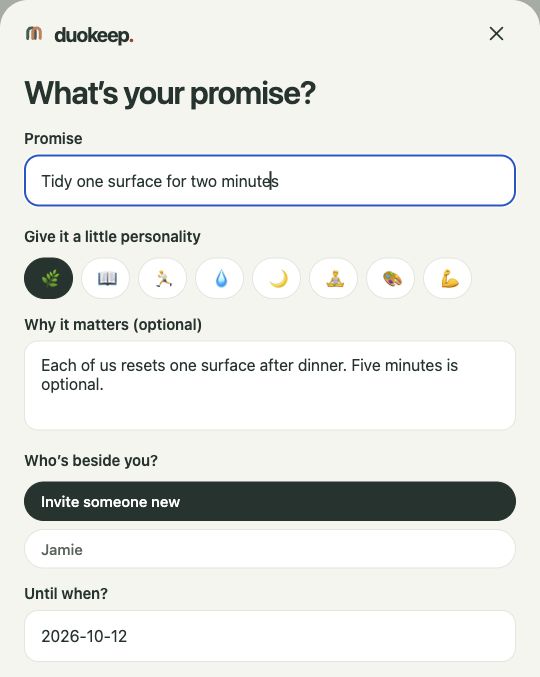
DuoKeep suits this setup when you both want one goal and a separate record of each person’s action.
Your pair gets one active goal free. Check the iPhone listing or Android listing for availability and current product details.

DuoKeep · Habits for two
One goal. Two people.
Start together.
Build a daily habit with a friend or partner. Each person checks in separately, and each pair gets one active goal free.
Free to start. DuoKeep Plus is optional. Store availability and purchase prices vary by country.
Record your action, including days you rest
Each person records their own completion or rest day.
After meeting the agreed two-minute rule, choose I did it and save the entry. You can add a short note such as “Desk reset, two minutes.” Choosing Take a rest day records a rest rather than a completed action.
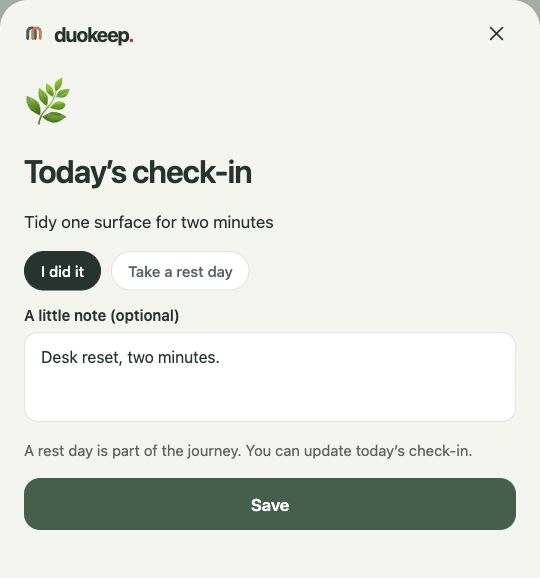
Your Done entry records your own action. Your partner still needs to submit their own report; your completion does not fill in their entry.
Agree on the completion rule yourselves. In this example, two minutes earns Done; DuoKeep records your report without measuring the tidying.
What happens to a shared streak?
A shared-streak day requires both people to report Done on the same goal date.
A rest entry does not add a completed day. Yesterday’s streak can remain visible while today is open; after a day ends without both completions, that day interrupts the streak. The earlier check-in history remains available.
Choose this rule if you want to count days when you both did the action.
If you plan to do something only twice a week and want a streak that ignores all other days, choose a tracker with scheduling rules that match that plan.
How can you follow up without repeated reminders?
Agree on whether either person wants a message, and when, before starting.
A possible arrangement is one check-in after dinner and one reminder only if requested. Ask “Are you keeping the two-minute plan tonight, or taking a rest?” rather than deciding what the other person ought to do.
If one person no longer wants the habit, pause the shared arrangement and discuss another action.
You can keep your own routine without asking your partner to maintain a shared streak.
What if you live in different time zones?
Check the time zone in the DuoKeep goal details.
The goal uses one shared date based on the creator’s device time zone when it was created. Agree on a check-in time that fits that date for both people; two local evenings may belong to different goal dates.
For example, a goal created in Tokyo uses UTC+9. A partner at UTC+1 reporting at 9 p.m. on October 6 is reporting at 5 a.m. on October 7 in Tokyo.
If you each report at 9 p.m. locally on October 6, those reports belong to different goal dates. Compare your intended reporting times before relying on a shared streak.
For the same Tokyo-based goal, a Tokyo check-in at 9 p.m. on October 6 and a UTC+1 check-in at 1 p.m. on October 6 belong to the same goal date. These times are an example; you can choose different reporting times within that shared date.
Compare the time zones shown on your devices with the goal time zone when choosing your reporting times. If no comfortable daily reporting window works for both people, focus on each person’s record or choose a tracker with date and scheduling rules that fit your arrangement.
Review the first week using both records
Look at each person’s completed actions and the dates when both completed.
Those counts answer different questions. Use the record to identify a rule or time that needs changing, then ask whether both people want another week.
| Day | Alex | Sam |
|---|---|---|
| 1 | Done | Done |
| 2 | Done | Done |
| 3 | Rest | Done |
| 4 | Done | Done |
| 5 | Rest | Rest |
| 6 | Done | Done |
| 7 | Done | Unreported |
In this example, Alex completed five days, Sam completed five, and both completed on four days: 1, 2, 4, and 6.
Four is the total number of jointly completed days, not a four-day streak. Day 7 remains unreported for Sam until Sam submits an entry; Alex’s Done does not fill it in.
Ask what happened on days 3, 5, and 7 before changing the target.
If the chosen time was difficult, try another cue. If the two-minute action was unwanted, choose another action. If the action happened but the report was forgotten, adjust the reporting reminder.
Did each of us still want this habit? Was the completion rule clear? Did the check-in time fit both schedules? For the next week, what one part will we keep or change?
A week is a practical point to review the arrangement, not a promise that the action has become automatic.
You can repeat the same plan, adjust it, or end it by agreement. Keep the completed records separate from the decision to continue.
Questions before starting a couple’s habit
Do we need to do the habit together at the same time?
No. In this plan, each person completes and records their own action within the shared goal date.
You can read or tidy at different times. Choose an action that requires meeting only if both schedules allow it.
Can we use different phones?
DuoKeep has iPhone and Android versions, and pairs join through a code or QR code.
Check that each person can install the app in their country. You need an internet connection to sync your records.
What if my partner does not want a tracking app?
Use a shared note or an agreed message if both people want the habit but not another app.
If your partner does not want the habit either, start your own routine. A shared tracker works only when both people choose to participate.
Product details and method
The product explanations use DuoKeep’s App Store description, Google Play listing, and developer-checked goal, invitation, and streak rules. The alternative sharing format uses HabitShare’s official page. The plan, suggested wording, and sample week were created for this guide; the sample counts and time conversions were checked directly.
The screenshots come from DuoKeep’s local web preview, filled through its interface with this guide’s example. We checked goal creation and local saving: the sample entry changed You to Done while the goal showed Invitation pending and a zero-day shared streak. We did not test an invitation, cross-phone sync, or a week-long habit trial.
If you have agreed on one daily action and want both people’s reports in one place, create your pair’s first goal in DuoKeep.
Keep the completion rule small enough for your own schedules, and choose the end-of-week review date together.
DuoKeep · Habits for two
One goal. Two people.
Start together.
Build a daily habit with a friend or partner. Each person checks in separately, and each pair gets one active goal free.
Free to start. DuoKeep Plus is optional. Store availability and purchase prices vary by country.
More habit guides
Browse our habit guides for choosing an app and planning a goal together.

Habit guide
How to Find an Accountability Partner Who Fits Your Goal
Find an accountability partner through friends, Reddit, or matching services. Compare costs, copy an invitation, and plan a seven-day trial.
Read the guide
Habit guide
Best Shared Habit Tracker Apps for Two People (2026)
Compare shared habit tracker apps for couples and friends. Check two-person costs, rest days, privacy, and how shared daily goals work.
Read the guide